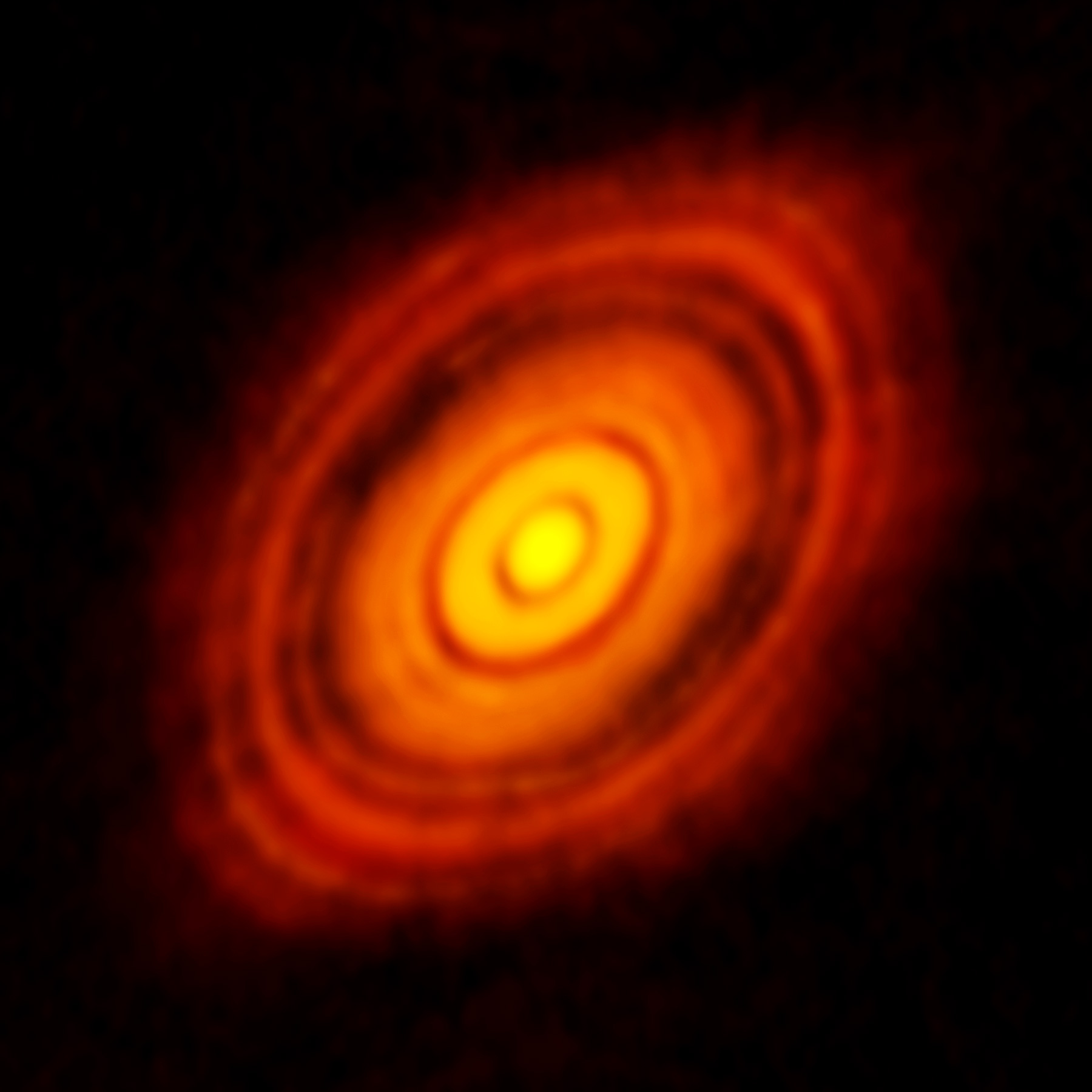
A Picture of a Planet Being Born
Far, far away in space, a young star is wrapped in a giant ring of dust and gas. It looks a bit like a flat, glowing donut floating in the dark. Astronomers (scientists who study space) pointed powerful telescopes at it and spotted something amazing — a tiny new planet forming right inside that ring!
This is super special. We have found thousands of planets around other stars, but it is very rare to actually catch one while it is still being made. It is like seeing a baby chick the moment it hatches instead of meeting a grown-up bird later.
How Does a Planet Get Made?
Young stars are born inside huge clouds of gas and dust. As the star spins, the leftover material flattens into a swirling disk around it, called a protoplanetary disk. Think of pizza dough being spun until it goes flat and round.
Inside that disk, tiny dust grains bump into each other and stick together, like snowflakes clumping into a snowball. Over a very long time, these clumps grow bigger and bigger until — ta-da! — a planet is born.
Reading the Clues in the Ring
The ring around the star is not perfectly smooth. It has gaps and curls, a bit like the swirly patterns you see in stirred hot chocolate. These gaps are big clues, because a growing planet sweeps up dust as it moves, leaving an empty path behind it.
By studying these gaps and glowing spots, scientists can figure out where a hidden baby planet might be hiding. Sometimes they get lucky and snap a direct photo of the little world itself.
Why This Is So Exciting
Watching a planet form helps scientists understand how our own Earth, Mars, and Jupiter were made about 4.5 billion years ago. We can't travel back in time to see baby Earth, but watching other young star systems is the next best thing.
It also helps us learn whether faraway planets might be cozy places where life could one day exist. Every new picture adds a piece to the giant puzzle of how worlds are built.
The Tools That Make It Possible
To see something this tiny and far away, astronomers use enormous telescopes, like the ALMA telescope in Chile and the James Webb Space Telescope in space. These machines can spot faint light and heat that our eyes could never catch.
Many telescopes can even work together as a team, combining their views to make one super-sharp image. It is like a group of friends sharing puzzle pieces to see the whole picture.